The world of medicinal plants offers an extraordinarily rich heritage of species that have been used for centuries to support overall well-being. Among these, White Mulberry holds a special place: a plant known primarily for its association with silkworm farming, but which is now
attracting increasing interest in the fields of herbal medicine and nutraceuticals.
The leaves of Morus alba are naturally rich in a variety of bioactive compounds, including flavonoids, polyphenols and, above all, 1-deoxynojirimycin, commonly abbreviated as 1-DNJ, a particular compound belonging to the iminosugar family.
It is precisely the presence of 1-DNJ that has made White Mulberry particularly interesting in the context of carbohydrate metabolism.
What is White Mulberry?
White Mulberry (Morus alba L.) is a tree belonging to the Moraceae family.
It can reach considerable dimensions and has a broad, highly branched crown. The leaves are generally bright green and vary in shape: they may be entire or lobed, a characteristic feature of the Morus genus.
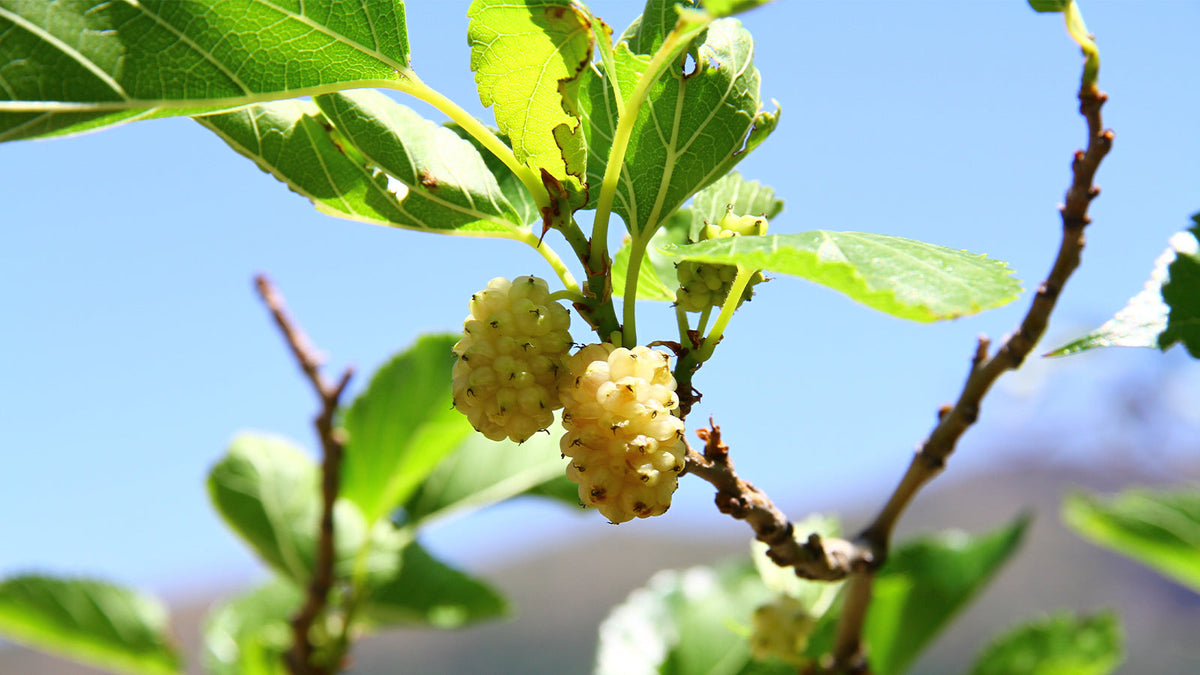
The flowers are small and inconspicuous and appear in separate or associated inflorescences. The fruits, commonly known as mulberries, are fleshy infructescences which, when ripe, may range in colour from whitish to pink or purplish, depending on the variety.
Geographical Origin
White Mulberry is native to Asia, particularly to areas extending between China and Central Asia, but over the centuries it has spread widely to many other parts of the world.
As mentioned above, its cultivation is closely linked to the history of sericulture: mulberry leaves are, in fact, the main food source for the silkworm (Bombyx mori).
Mulberry cultivation subsequently spread to Europe as well, where the plant is now found both as a cultivated species and, in some areas, as a naturalised plant.
Etymology
The name of the genus Morus derives from the Latin morus, the term used for the mulberry tree, while alba means “white” and refers primarily to the light colour of the fruit.
White Mulberry is known by different traditional names in various Asian cultures, including Sang Shen in Chinese. It has also been used for centuries in Traditional Chinese Medicine (TCM), where different parts of the plant have been employed for a variety of purposes.
Traditional Use
Mulberry has a long history of traditional use.
In particular, White Mulberry leaves have traditionally been used in Eastern cultures mainly in the form of a decoction, to which hypoglycaemic, as well as antiseptic and expectorant, properties were attributed.
White Mulberry and Carbohydrate Metabolism (In Italy)
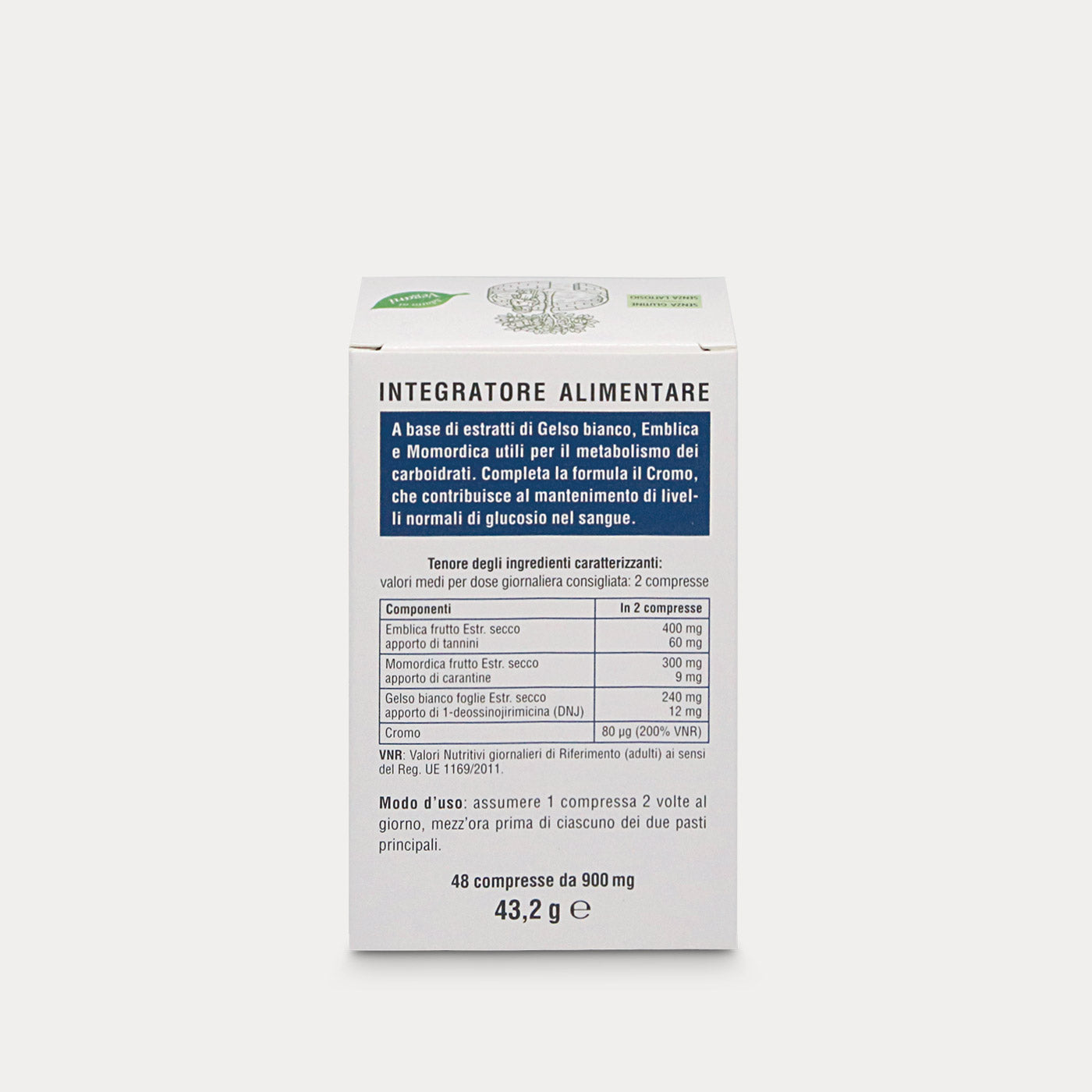
Today, White Mulberry leaves are also used in food supplements, particularly in formulations intended to support carbohydrate metabolism.
The Italian Ministry of Health lists “Carbohydrate metabolism” among the physiological effects associated with Morus alba L., with reference to the plant parts covered by the relevant provisions, including the leaves.
The particular interest in this plant is mainly related to the composition of its leaves and the presence of specific naturally occurring active compounds, including 1-DNJ.
How 1-DNJ Works: The Characteristic Compound in White Mulberry Leaves
1-Deoxynojirimycin, generally abbreviated as 1-DNJ or DNJ, is a naturally occurring compound whose chemical structure is very similar to that of glucose, with one fundamental difference: in the sugar ring, a nitrogen atom replaces the characteristic oxygen atom.
This small structural difference enables it to interact with intestinal α-glucosidases.
Alpha-glucosidases are a group of enzymes located on the cell membrane of enterocytes, the epithelial cells lining the villi of the small intestine. They are responsible for breaking down complex carbohydrates, such as starch, into simple sugars such as glucose.
Their inhibition therefore slows the release of sugars into the bloodstream, influencing their availability after a meal.
White Mulberry in Food Supplements: Quality and Benefits
White Mulberry (Morus alba L.) is one of the plants of particular interest when it comes to physiological support for carbohydrate metabolism. Its distinctive feature is mainly associated with its leaves, which are naturally rich in bioactive compounds, including 1-DNJ, which, as we have seen, has been studied for its ability to inhibit the α-glucosidases involved in carbohydrate digestion.
Once again, nature offers us a plant of considerable interest: White Mulberry combines a history spanning thousands of years, a particularly interesting phytochemical composition, and a well-defined role in the field of carbohydrate metabolism, with 1-DNJ representing one
of its key constituents.
Dr Andrea Cima – Pharmacist and Research & Development Specialist – Erbamea